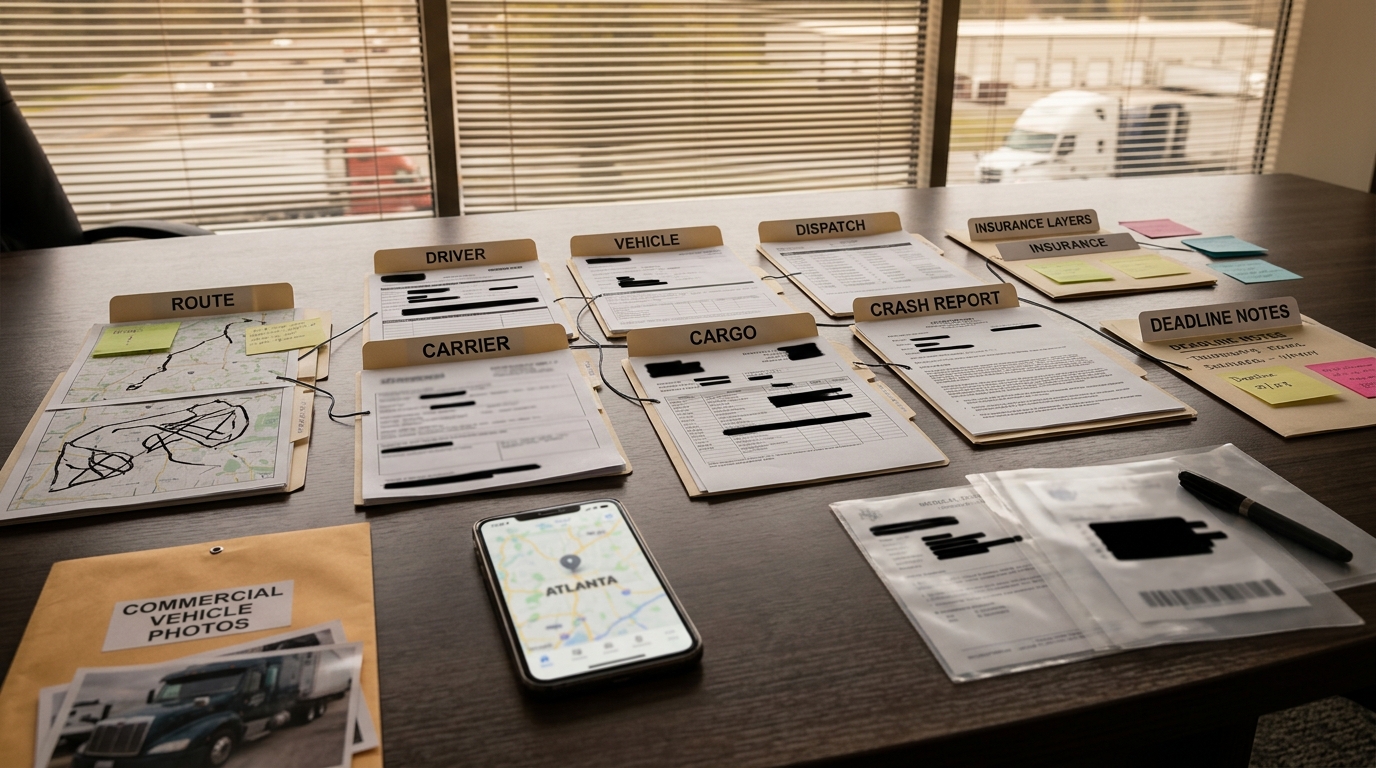
Atlanta is not just a commuter city. It is a freight, airport, warehouse, delivery, construction, and regional logistics hub. Every day, tractor-trailers, box trucks, delivery vans, dump trucks, work trucks, utility vehicles, shuttle buses, rideshare vehicles, couriers, service vans, and commercial fleets move through the metro area.
When one of those vehicles causes a crash, the claim may be more complicated than an ordinary car accident. The driver may not be the only responsible party. The company may control key records. The vehicle may have electronic data. The route may involve dispatch instructions. The cargo may matter. Multiple insurance policies may be involved.
This guide explains what to know after a commercial vehicle accident in Atlanta’s logistics network, what evidence may matter, what records may disappear, and when legal guidance may be useful.
Quick Answer
After a commercial vehicle accident in Atlanta, get to safety, call 911 when needed, seek medical care, photograph the vehicles and company markings, collect driver and witness information, identify the company or carrier, note the route and location, track the crash report, save medical and repair records, notify insurance carefully, and preserve evidence related to the driver, vehicle, cargo, dispatch, maintenance, electronic data, and insurance coverage.
If the crash involved a truck, delivery van, box truck, shuttle, construction vehicle, service vehicle, or company-owned vehicle, speaking with atlanta commercial vehicle accident lawyers may help you understand what records should be preserved and which companies or insurers may be involved.
Key Takeaways
- Commercial vehicle accidents often involve more records than ordinary car crashes.
- Key evidence may include driver files, company safety records, vehicle maintenance, inspection records, dispatch instructions, delivery schedules, ELD data, dashcam footage, cargo records, and insurance policies.
- Atlanta’s logistics network includes freeway corridors, warehouse districts, airport-area traffic, construction routes, business districts, retail delivery zones, and neighborhood service routes.
- The company, carrier, vehicle owner, cargo loader, maintenance vendor, broker, shipper, or another business may need to be reviewed depending on the facts.
- Georgia injury deadlines and shared-fault rules can affect commercial vehicle injury claims.
- Evidence may disappear quickly unless it is identified and preserved early.
The Logistics-Chain Evidence Map
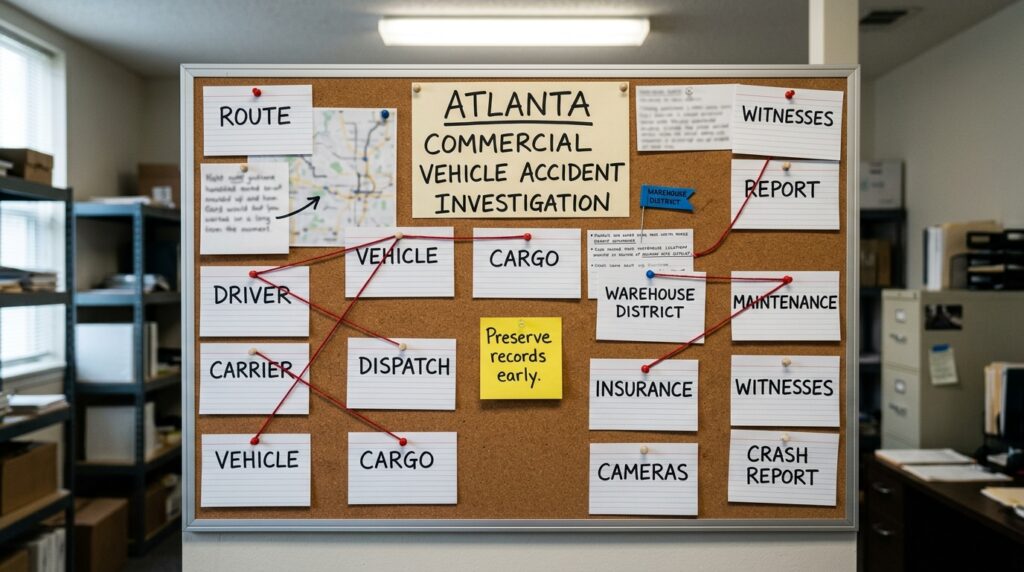
A commercial vehicle crash is not only about two vehicles colliding. It may involve an entire logistics chain.
A useful evidence map asks:
- Who was driving?
- Who owned the vehicle?
- Who employed or contracted with the driver?
- What company name appeared on the vehicle?
- What route was the vehicle taking?
- What delivery, service, or job was underway?
- Was the driver using an app, dispatch device, or company route sheet?
- Was the vehicle inspected and maintained?
- Was cargo loaded safely?
- Was the driver tired, distracted, rushed, or over schedule?
- What insurance policies may apply?
- What company records should be preserved?
That is why commercial vehicle cases often require fast evidence work. The most important records may be controlled by the company, not by the injured person.
What Counts as a Commercial Vehicle Accident?
A commercial vehicle accident may involve more than an 18-wheeler.
Examples include:
- Tractor-trailers
- Semi-trucks
- Box trucks
- Delivery vans
- Cargo vans
- Utility trucks
- Work trucks
- Dump trucks
- Concrete trucks
- Garbage trucks
- Shuttle buses
- Charter buses
- Passenger vans
- Company cars
- Construction vehicles
- Tow trucks
- Couriers
- Food delivery vehicles
- App-based delivery vehicles
- Rideshare vehicles
- Medical transport vehicles
- Airport shuttle vehicles
The key issue is whether the vehicle was being used for business, employment, delivery, transportation, service, construction, freight, passenger movement, or another commercial purpose.
Why Atlanta Commercial Vehicle Claims Are Different
Atlanta commercial vehicle accidents can be more complex because the crash may involve:
- Multiple companies
- Multiple insurance policies
- A driver and a separate vehicle owner
- A carrier or fleet operator
- A contractor relationship
- A broker or shipper
- A maintenance company
- Cargo loading issues
- Federal motor carrier rules
- Georgia commercial vehicle enforcement issues
- Company cameras or telematics
- Electronic logging devices
- Dispatch and route data
- Delivery deadlines
- Employee training and supervision records
In an ordinary car accident, the main records may be photos, insurance details, a crash report, medical records, and repair estimates. In a commercial vehicle accident, those records still matter, but they may only be the beginning.
Atlanta’s Logistics Network: Where These Crashes Happen
Commercial vehicle crashes can happen anywhere in Atlanta, but several settings may create specific evidence issues.
Freeway and Connector Corridors
Crashes on I-75, I-85, I-20, I-285, GA-400, or the Downtown Connector may involve tractor-trailers, box trucks, work trucks, delivery vans, buses, and commercial fleet vehicles.
Potential evidence:
- Dashcam footage
- ELD or driver log data
- Lane-position details
- Vehicle resting positions
- Tow records
- Witness information
- Crash report details
- Company route records
- Dispatch messages
- Inspection records
Warehouse, Industrial, and Freight Areas
Commercial traffic may be heavy near warehouses, distribution centers, loading docks, rail-adjacent corridors, industrial parks, and freight routes.
Potential evidence:
- Loading dock records
- Delivery appointment records
- Cargo documents
- Driver check-in records
- Gate camera footage
- Yard camera footage
- Vehicle inspection records
- Trailer numbers
- Company communications
Airport and Hotel Shuttle Routes
Airport-area and hotel-zone crashes may involve shuttles, buses, taxis, rideshare vehicles, delivery vans, luggage transport vehicles, and commercial passenger carriers.
Potential evidence:
- Shuttle company records
- Passenger lists, when available
- Trip logs
- Vehicle maintenance files
- Surveillance footage
- Driver schedule records
- Insurance information
- Witness names
Downtown, Midtown, Buckhead, and Event Areas
Dense commercial zones may involve rideshare pickups, food delivery vehicles, parcel vans, contractors, buses, hotel loading areas, valet lanes, scooters, pedestrians, and cyclists.
Potential evidence:
- Business camera notes
- Rideshare or delivery app records
- Delivery timestamps
- Parking or loading-zone photos
- Witness information
- Crosswalk and signal photos
- Driver communications
Construction and Utility Routes
Construction vehicles and utility trucks may operate near lane closures, work zones, temporary signage, cones, equipment, and roadway changes.
Potential evidence:
- Work orders
- Jobsite records
- Traffic-control plans
- Construction-zone photos
- Vehicle inspection records
- Company safety policies
- Maintenance records
- Supervisor communications
Georgia’s Atlanta Perimeter Truck Restriction Issue
Commercial vehicle routing can matter. Georgia law restricts certain commercial vehicles and vehicles with more than six wheels from traveling on portions of I-20, I-75, I-85, and GA-400 inside the I-285 perimeter unless an exception applies.
That does not automatically prove fault in a crash. But routing questions may matter if a commercial vehicle was using a restricted route, making a delivery inside the perimeter, traveling to a terminal, responding to a permitted need, or moving through a dense area where commercial routing rules apply.
After a crash, write down:
- Roadway
- Direction of travel
- Nearest exit
- Whether the vehicle appeared to be making a delivery
- Company markings
- Trailer number
- USDOT number, if visible
- Destination clues
- Route details from any delivery paperwork or app screenshot
- Whether the vehicle was inside or outside the I-285 perimeter
Routing can become part of the larger evidence map.
First Steps After a Commercial Vehicle Accident
The first steps should protect safety and preserve information.
1. Move to Safety
If possible, move out of active traffic. Do not stand near a commercial vehicle, trailer, cargo spill, leaking fluid, work zone, or active lane.
2. Call 911 When Needed
Call 911 if anyone is hurt, the commercial vehicle blocks traffic, cargo spilled, a driver left, the vehicle cannot be moved, hazardous materials may be involved, or the crash is serious.
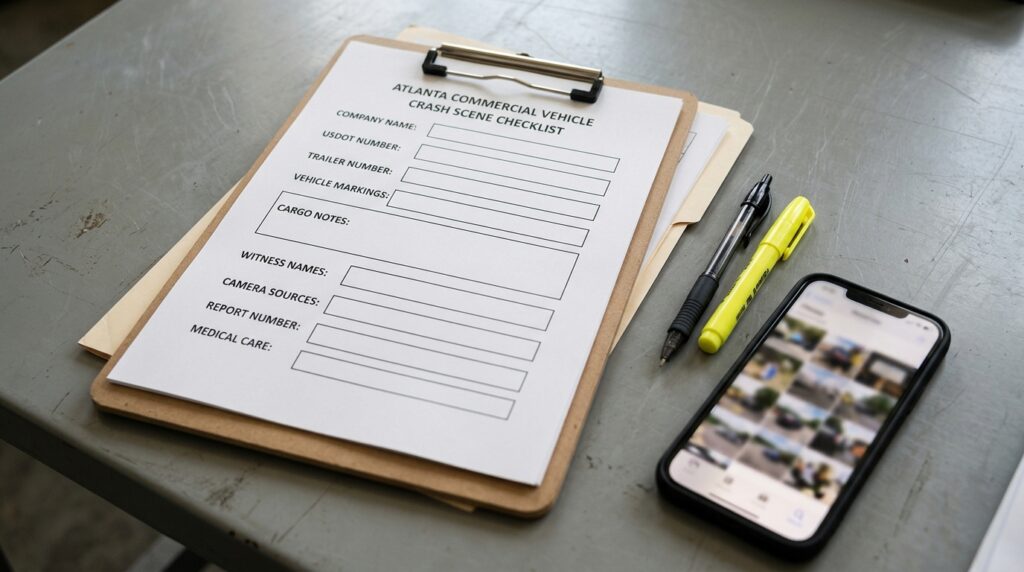
3. Photograph the Vehicle and Company Markings
If safe, photograph:
- Vehicle damage
- License plates
- Company name
- USDOT number
- MC number, if visible
- Trailer number
- Cab number
- Vehicle markings
- Cargo markings
- Final vehicle positions
- Road layout
- Traffic signs and signals
- Skid marks or debris
- Construction cones or lane shifts
- Nearby cameras
Do not place yourself in danger to take photos.
4. Collect Witness Information
Witnesses may include other drivers, passengers, pedestrians, cyclists, workers, security guards, warehouse staff, loading dock employees, rideshare passengers, hotel staff, or business employees.
5. Seek Medical Care
Commercial vehicle crashes can cause serious injuries even when the injured person initially feels “okay.” Seek care for headaches, dizziness, neck pain, back pain, numbness, chest pain, abdominal pain, confusion, shoulder pain, knee pain, or symptoms that appear later.
Crash Reports and Official Records
A crash report may document the accident date, time, location, parties, vehicles, insurance information, reported injuries, citations, contributing factors, witness information, and officer observations.
The Georgia Motor Vehicle Crash Report, also known as GDOT-523, is the official document used by Georgia law enforcement agencies to collect and disseminate crash data.
For Atlanta crashes, the Atlanta Police Department’s Open Records Unit directs people seeking a single report to the Central Records Unit and provides accident-report access information.
Commercial vehicle crashes may also involve additional layers of reporting or investigation, especially if the crash involved serious injury, death, hazardous materials, a commercial carrier, or enforcement by state commercial vehicle authorities.
Save:
- Crash report number
- Responding agency
- Officer name, if known
- Crash date
- Crash time
- Crash location
- Driver and vehicle details
- Insurance information
- Company name
- USDOT number, if visible
- Trailer number, if any
- Witness information
- Citation details, if any
A crash report is important, but it is not the complete evidence file.
Company and Carrier Records That May Matter
Commercial vehicle claims often turn on records controlled by the business.
Important records may include:
- Driver qualification file
- Driver training records
- Driver schedule
- Dispatch records
- Route plan
- Delivery deadline records
- Trip sheets
- Bills of lading
- Cargo documents
- Loading records
- Weight tickets
- Inspection records
- Maintenance records
- Repair history
- Brake records
- Tire records
- Safety policies
- Prior incident records
- Hiring and supervision records
- Cell phone or communication records
- Dashcam footage
- Telematics data
- GPS history
- ELD data, when applicable
These records may show whether the driver was properly trained, whether the vehicle was maintained, whether cargo was loaded correctly, whether the driver was pressured by a delivery schedule, or whether the company had safety problems before the crash.
Electronic Evidence: ELD, Telematics, Dashcam, and GPS
Commercial vehicles may create electronic records.
Depending on the vehicle and company, relevant data may include:
- Electronic logging device data
- Hours-of-service information
- GPS location history
- Speed data
- Hard braking events
- Sudden acceleration events
- Lane departure events
- Dashcam video
- In-cab camera footage
- Dispatch messages
- App-based delivery timestamps
- Mobile device records
- Vehicle diagnostic data
An electronic logging device may automatically record driving time and other hours-of-service records. Some systems may also capture movement, miles driven, engine operation, and related data.
Electronic evidence can disappear or be overwritten. It should be identified early.
FMCSA and SAFER Records
If the vehicle was part of an interstate motor carrier operation, federal records may help identify the carrier and basic safety information.
The FMCSA SAFER Company Snapshot can show company identification, size, commodity information, safety rating if any, roadside out-of-service inspection summary, and crash information. It may be searchable by company name, USDOT number, or MC/MX number.
This does not replace discovery in a legal claim, and it does not prove fault by itself. But it can help identify the carrier and basic public safety information.
Commercial Vehicle Enforcement in Georgia
Georgia has state-level commercial vehicle enforcement. Commercial Vehicle Enforcement officers conduct safety inspections of commercial vehicles, operators, and loads. Those inspections are designed to identify whether the vehicle, driver, or load poses a safety risk to the motoring public.
That matters because commercial vehicle crash claims may involve more than driver behavior. Vehicle condition, load condition, inspection history, and safety compliance may all become part of the evidence review.
Insurance Layers in Commercial Vehicle Accidents
Commercial vehicle crashes may involve several possible insurance layers.
Potential coverage sources may include:
- Driver’s personal policy
- Employer policy
- Commercial auto policy
- Motor carrier policy
- Trailer owner policy
- Cargo policy
- Rideshare or delivery platform coverage
- Contractor policy
- Maintenance vendor policy
- Broker-related coverage
- Excess or umbrella coverage
- Uninsured/underinsured motorist coverage
- Medical payments coverage
- Health insurance
The insurance company that calls first may not be the only insurer involved. Before accepting a settlement, it is important to understand who owned the vehicle, who employed the driver, who controlled the route, and what coverage layers may apply.
Injuries After Atlanta Commercial Vehicle Crashes
Commercial vehicle accidents may cause serious injuries because of vehicle weight, height, cargo, speed, blind spots, and impact forces.
Potential injuries may include:
- Traumatic brain injuries
- Concussions
- Neck injuries
- Back injuries
- Disc injuries
- Spinal cord injuries
- Shoulder injuries
- Knee injuries
- Fractures
- Crush injuries
- Internal injuries
- Burns
- Scarring
- Nerve damage
- Psychological trauma
- Fatal injuries
Save records from:
- Emergency medical services
- Emergency rooms
- Urgent care clinics
- Primary care physicians
- Orthopedic specialists
- Neurologists
- Imaging centers
- Physical therapy providers
- Pharmacies
- Mental health providers, if used
- Rehabilitation providers
Also save medical bills, prescriptions, discharge instructions, imaging reports, work restriction notes, follow-up records, and therapy attendance logs.
Repair, Rental, Wage, and Daily-Life Records
Commercial vehicle crashes can disrupt work, transportation, family routines, and daily life.
Save:
- Vehicle damage photos
- Repair estimates
- Supplemental repair estimates
- Body shop invoices
- Total-loss valuation paperwork
- Rental car receipts
- Towing receipts
- Storage bills
- Personal property damage receipts
- Pay stubs
- Timesheets
- Employer letters
- Missed-shift confirmations
- Tax records
- Work restriction notes
- Contractor invoices
- Medical travel receipts
- Recovery journal notes
A short recovery journal can help document pain levels, mobility limits, sleep problems, difficulty driving, anxiety, medication effects, missed activities, and changes in work or family responsibilities.
Common Disputes in Commercial Vehicle Accident Claims
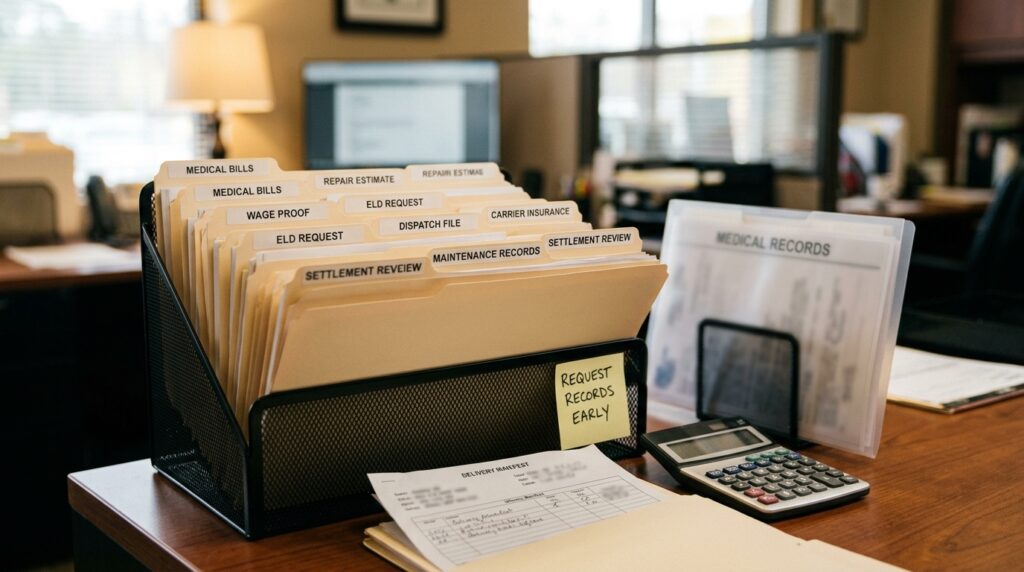
Commercial vehicle accident claims may involve disputes that do not appear in ordinary crashes.
Common disputes include:
- The company denies the driver was working.
- The driver claims they were off duty.
- The carrier denies ownership or control of the vehicle.
- The insurer disputes which policy applies.
- The company delays producing records.
- The driver blames traffic, weather, or another vehicle.
- The insurer argues the injured person was partly at fault.
- The company says the vehicle was properly maintained.
- The cargo company denies loading problems.
- The insurer disputes the injury timeline.
- The insurer claims treatment was delayed or unrelated.
- The insurer says policy limits are lower than expected.
- The company refuses to preserve camera footage.
- The insurer makes a quick offer before records are complete.
A commercial vehicle claim should not be evaluated based only on the police report or the first insurance call.
Who May Be Responsible?
Depending on the facts, potential responsible parties may include:
- Commercial vehicle driver
- Driver’s employer
- Motor carrier
- Vehicle owner
- Trailer owner
- Cargo loader
- Shipper
- Broker
- Maintenance company
- Repair shop
- Dispatching company
- Rideshare or delivery platform
- Construction contractor
- Government entity in limited roadway or vehicle cases
- Another negligent driver
This does not mean every party is responsible in every case. It means each role should be reviewed before the claim is resolved.
What To Ask During a Legal Consultation
Bring direct questions to the first conversation.
Ask:
- What records should be preserved immediately?
- Who owned the commercial vehicle?
- Was the driver working at the time?
- Was the driver an employee or contractor?
- What company controlled the route or delivery?
- Should ELD data be requested?
- Should dashcam or telematics data be preserved?
- What maintenance records may matter?
- What cargo records may matter?
- What insurance policies should be reviewed?
- What if the company denies responsibility?
- What if the driver was using a delivery app?
- What if the vehicle was leased or rented?
- What if a broker or shipper was involved?
- What deadlines may apply?
- How should insurance calls be handled?
A good consultation should clarify the evidence map, not just discuss a settlement number.
Georgia Deadlines and Shared-Fault Rules
Georgia commercial vehicle accident claims are time-sensitive. In many cases, actions for injuries to the person must be brought within two years after the right of action accrues under Georgia Code Section 9-3-33.
That does not mean you should wait. Commercial vehicle evidence may disappear quickly. Video may be overwritten, ELD data may be replaced, vehicles may be repaired, drivers may change jobs, cargo records may be archived, and dispatch records may become harder to locate.
Georgia law can also affect recovery when fault is disputed. Under Georgia Code Section 51-12-33, a plaintiff is not entitled to damages if the plaintiff is 50 percent or more responsible for the injury or damages claimed.
Commercial vehicle insurers may argue that the injured person was speeding, distracted, in a blind spot, following too closely, or failed to avoid the crash. Evidence is especially important when responsibility is disputed.
Mistakes to Avoid After a Commercial Vehicle Accident
Avoid these common mistakes:
- Leaving the scene too quickly
- Failing to photograph company markings
- Forgetting to capture the USDOT number
- Not collecting witness information
- Waiting too long to seek medical care
- Assuming the driver is the only responsible party
- Assuming the first insurer is the only insurer
- Giving broad recorded statements
- Guessing about speed, distance, timing, or fault
- Signing broad medical authorizations
- Repairing the vehicle before taking damage photos
- Throwing away damaged property
- Failing to ask about electronic evidence
- Accepting a quick settlement before records are complete
- Waiting too long to ask about deadlines
Commercial vehicle claims are evidence-heavy. Early mistakes can make important records harder to obtain.
Commercial Vehicle Accident Checklist
Use this checklist after an Atlanta commercial vehicle accident.
At the Scene
- Move to safety
- Call 911 when needed
- Get medical care
- Photograph vehicle damage
- Photograph company markings
- Photograph license plates
- Photograph USDOT or MC numbers, if visible
- Photograph trailer number or cab number
- Note cargo or load details
- Collect witness names and phone numbers
- Look for nearby cameras
- Save the crash report number
Records to Preserve
- Crash report
- Medical records and bills
- Repair estimates
- Rental and towing receipts
- Wage proof
- Photos and videos
- Dispatch or delivery clues
- App screenshots, if relevant
- Insurance letters
- Settlement documents
- Work restriction notes
Records to Ask About
- Driver qualification file
- Training records
- ELD data
- Hours-of-service records
- Dispatch records
- Route plan
- Maintenance records
- Inspection records
- Cargo records
- Dashcam footage
- Telematics data
- Insurance policies
FAQ
What is a commercial vehicle accident?
A commercial vehicle accident involves a vehicle being used for business, delivery, freight, passenger transport, service, construction, utility work, or another commercial purpose. It can involve a semi-truck, box truck, van, shuttle, company car, work truck, delivery vehicle, or other business vehicle.
Why are commercial vehicle accident claims more complicated?
They may involve company records, driver files, maintenance records, cargo documents, dispatch instructions, electronic data, multiple insurers, and more than one responsible party.
What should I photograph after a commercial vehicle crash?
Photograph vehicle damage, license plates, company markings, USDOT numbers, trailer numbers, road layout, traffic signs, cargo clues, skid marks, debris, nearby cameras, and visible injuries if safe.
What is an ELD?
An electronic logging device is technology used in certain commercial vehicles to automatically record driving time and other hours-of-service records.
Why does the USDOT number matter?
A USDOT number can help identify a motor carrier and may help locate public safety and company information through federal systems.
Can the company be responsible for the driver’s crash?
Possibly. It depends on the facts, including whether the driver was working, who owned the vehicle, who controlled the route, whether the driver was properly trained, and whether negligent hiring, supervision, maintenance, dispatch, or loading issues contributed.
What if the driver was an independent contractor?
The contractor label does not end the analysis. Vehicle ownership, route control, app use, dispatch instructions, insurance, and company relationships may still need review.
What if a delivery app vehicle caused the crash?
Save app screenshots, trip or delivery details, driver information, vehicle details, insurance messages, crash report information, and any communications from the platform or insurer.
How long do I have to file a commercial vehicle injury lawsuit in Georgia?
In many Georgia injury cases, the general deadline is two years after the right of action accrues. Some claims may involve shorter notice rules or different deadlines.
Is this article legal advice?
No. This article is for general informational purposes only. Anyone dealing with a specific commercial vehicle accident claim should speak with a qualified legal professional about their situation.
Final Thoughts
Commercial vehicle accidents in Atlanta are not just crash claims. They are records cases. The driver, route, carrier, dispatch system, vehicle maintenance, cargo, electronic data, and insurance layers may all matter.
The strongest next step is to build a logistics-chain evidence map early. Preserve photos, identify the company, track the crash report, save medical and repair records, ask about electronic data, and review every possible insurance layer before important evidence disappears.