
A car accident can leave you dealing with more than the immediate inconvenience of vehicle damage.
Neck stiffness, back discomfort, headaches, soreness, restricted movement, and other symptoms can affect how you work, sleep, drive, and handle ordinary activities.
The challenge is that not every accident-related problem is obvious immediately.
Some people notice symptoms at the scene. Others begin feeling stiff or sore later that day or over the following days.
That is one reason an evaluation can be useful after a collision, particularly when symptoms develop or normal movement changes.
For Dallas residents researching an auto accident injury clinic, the important question is not simply where to find treatment.
It is understanding what an injury-focused clinic can evaluate, what chiropractic care may address, and how rehabilitation can fit into a broader recovery plan.
Why Accident Injuries Can Be Difficult to Recognize
The physical forces involved in a collision can affect muscles, joints, and other tissues.
Whiplash is one of the better-known examples.
Mayo Clinic describes whiplash as a neck injury caused by rapid back-and-forth movement of the neck, commonly associated with rear-end collisions. Symptoms can include neck pain and stiffness, reduced range of motion, headaches, shoulder or upper-back pain, and tingling or numbness in the arms.
Importantly, symptoms do not always appear immediately.
A person may initially feel relatively normal and later notice that turning their head, sitting, sleeping, or performing normal activities has become uncomfortable.
That does not mean every delayed symptom represents a serious injury. It does mean changes in symptoms or function should not automatically be dismissed.
What an Auto Accident Injury Clinic Actually Does
An injury-focused clinic should begin with understanding what happened and how your body has responded.
That means looking beyond a single complaint.
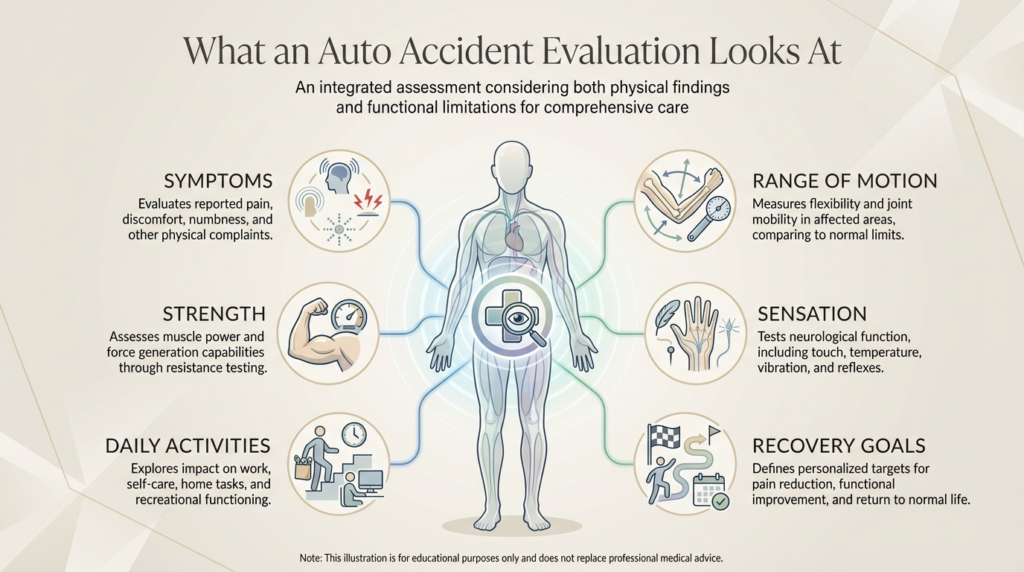
An evaluation may involve discussing:
- How the collision occurred
- When symptoms started
- Where symptoms are located
- Whether movement is restricted
- Which activities increase discomfort
- Whether strength or mobility has changed
- Whether sleep has been affected
- Whether driving has become difficult
- Whether work has been affected
Mayo Clinic notes that evaluating whiplash can involve assessing range of motion, tenderness, reflexes, strength, sensation, and the ability to perform everyday tasks.
That functional perspective matters.
Someone may say their neck pain is manageable while still being unable to comfortably turn their head to check a blind spot.
Another person may have relatively little discomfort while standing but develop significant symptoms after sitting at a desk for an extended period.
An evaluation helps put those differences into context.
What Can an Auto Injury Chiropractor in Dallas Address?
An auto injury chiropractor in Dallas may provide care for certain musculoskeletal problems following an accident.
Depending on the individual’s condition, chiropractic care may address concerns involving spinal and joint mobility and other musculoskeletal issues.
Premier Injury Clinics of DFW’s Dallas location describes accident-focused care for conditions including whiplash, neck pain, back pain, stiffness, soft-tissue injuries, headaches, joint pain, and mobility-related problems. It also describes chiropractic adjustments, rehabilitation therapy, mobility-focused exercises, soft-tissue therapies, and structured recovery plans.
That does not mean every accident requires chiropractic treatment.
A patient’s symptoms, examination findings, medical needs, and recovery goals should determine what type of care is appropriate.
In some situations, additional medical evaluation or diagnostic imaging may be necessary.
Chiropractic Care Is Not the Same as Rehabilitation
The two approaches can overlap within a broader recovery plan, but they are not identical.
Chiropractic care may focus on spinal and joint mobility and certain musculoskeletal concerns.
Rehabilitation can focus on active movement, strengthening, flexibility, endurance, coordination, and returning to functional activities.
For example, someone recovering from neck symptoms may need to work on restoring range of motion and gradually rebuilding strength and endurance.
Mayo Clinic explains that physical therapy for ongoing whiplash symptoms may involve exercises designed to strengthen muscles, improve posture, and restore movement.
This is why accident recovery should not necessarily be viewed as a choice between “chiropractic” and “rehabilitation.”
Depending on the patient, more than one type of care may have a role.
What Recovery Should Actually Try to Restore
Pain reduction is an important part of recovery.
But it is not the only goal.
A successful recovery should also move toward restoring everyday function.
Think about what you normally need to do:
Drive: Can you turn your head, sit comfortably, and control the vehicle without aggravating symptoms?
Work: Can you tolerate the physical or postural demands of your job?
Sleep: Can you find a comfortable position and remain asleep?
Household activities: Can you bend, reach, lift, walk, and perform ordinary responsibilities?
Exercise: Can you gradually return to appropriate physical activity?
These questions provide a more practical picture of recovery than simply asking whether pain exists.
Why Mobility Matters After an Accident
Movement restrictions can affect much more than the injured area.
A stiff neck can make driving more difficult.
Back discomfort can make prolonged sitting uncomfortable.
Shoulder limitations can affect reaching and lifting.
Reduced lower-body mobility can change the way someone walks or climbs stairs.
Restoring appropriate movement can therefore have a direct effect on everyday independence.
Mayo Clinic identifies restoring range of motion and returning to regular activities as important goals in treating whiplash.
The appropriate exercises or treatment techniques depend on the individual’s condition.
There is no universal recovery routine that should be applied to every accident patient.

What to Expect From a Structured Recovery Plan
A structured plan should answer several basic questions:
What is happening?
What needs attention?
What activities are currently difficult?
What type of care is appropriate?
How will progress be monitored?
What happens if symptoms change?
Premier Injury Clinics of DFW states that its Dallas accident treatment plans are tailored to each patient’s injuries, symptoms, and recovery progress. The clinic describes monitoring recovery and adjusting care as symptoms improve and mobility returns.
That individualized approach matters because two people involved in the same collision may have very different recovery needs.
One person may primarily need help with neck mobility.
Another may have back-related limitations that interfere with work.
Someone else may need a combination of rehabilitation and other medical care.
Recovery Should Be Connected to Your Real Routine
A clinic visit gives you one snapshot of your physical condition.
Your daily life gives you a much bigger picture.
Pay attention to what happens when you:
- Drive to work
- Sit at your desk
- Pick up groceries
- Climb stairs
- Sleep through the night
- Perform household tasks
- Exercise
- Return to your normal work responsibilities
Progress may show up as small changes.
You might be able to sit longer.
You might turn your head farther.
You might need fewer breaks at work.
You might sleep more comfortably.
You might be able to perform an activity that you had avoided since the collision.
Those changes can help show whether functional capacity is improving.
When an Injury May Need More Than Chiropractic Care
An auto accident injury clinic is not a substitute for emergency medical care.
Some symptoms require urgent evaluation.
For example, following a possible traumatic brain injury, concerning symptoms can include a worsening headache, repeated vomiting, confusion, unusual behavior, weakness or numbness, slurred speech, seizures, or loss of consciousness.
If serious symptoms occur, emergency medical evaluation is more appropriate than waiting for a routine chiropractic appointment.
Similarly, persistent or worsening symptoms should be discussed with an appropriate healthcare professional.
Mayo Clinic advises people experiencing neck pain or other whiplash symptoms after an accident to seek medical evaluation so that fractures or other injuries can be ruled out.
Choosing an Auto Accident Injury Clinic in Dallas
If you are comparing Dallas providers, consider more than location.
Look for a clinic that:
- Regularly handles accident-related injuries
- Performs an appropriate evaluation
- Explains the proposed treatment
- Considers your functional limitations
- Monitors recovery
- Understands when additional medical evaluation may be needed
- Individualizes care rather than applying the same plan to everyone
You can also ask how the clinic approaches rehabilitation.
A provider who considers your ability to work, drive, sleep, exercise, and perform daily activities is looking at a broader definition of recovery than simply asking whether a particular area hurts.
Questions to Ask Before Starting Care
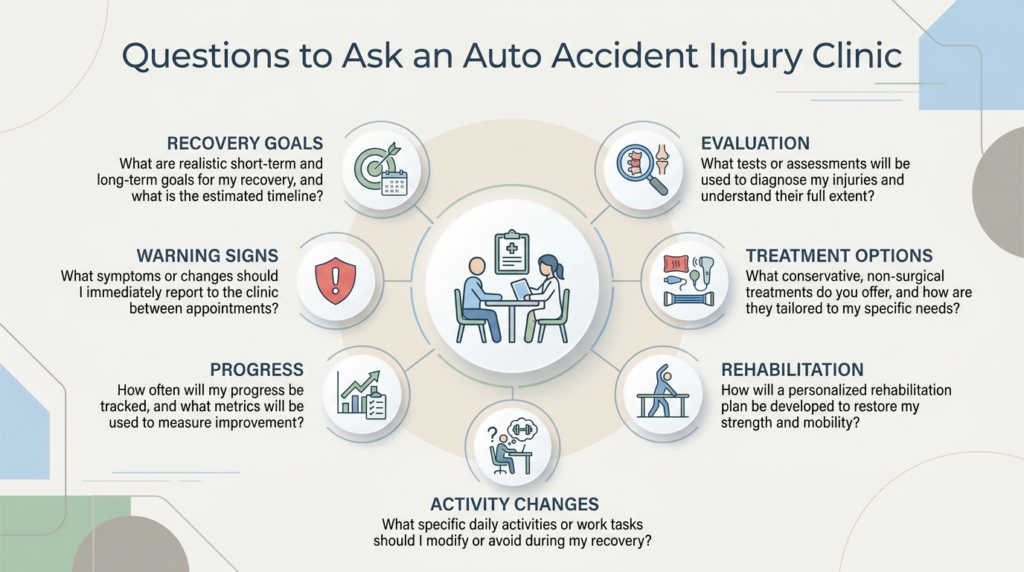
Before beginning treatment, you may want to ask:
What could be contributing to my symptoms?
Do I need additional medical evaluation?
What type of care is appropriate for my condition?
What activities should I modify temporarily?
How will my progress be monitored?
What should I do if my symptoms become worse?
What does a successful recovery look like for my situation?
These questions can help you understand the purpose of the recommended care.
Dallas Auto Accident Care With a Recovery-Focused Approach
Choosing an auto accident injury clinic is ultimately about more than finding somewhere to receive an adjustment.
It is about finding appropriate evaluation and care for the way the collision has affected you.
For some patients, that may involve chiropractic care.
For others, rehabilitation or additional medical evaluation may be more appropriate.
And for some, different forms of care may work together as part of a broader recovery plan.
Premier Injury Clinics of DFW’s Dallas location provides accident-focused chiropractic and rehabilitation services for patients recovering from auto accidents and other injuries. The clinic describes same-day appointments and transportation assistance for qualifying accident patients.
For Dallas residents researching an auto accident injury clinic, the most important first step is understanding what has changed since the collision and getting an appropriate evaluation.
From there, the right recovery strategy should be based on the injury, symptoms, functional limitations, and individual goals.
The objective is straightforward:
Restore movement, rebuild function, and work toward getting back to everyday life.
To learn more, visit Premier Injury Clinics of DFW’s Dallas auto accident injury services.