
Choosing medical scrubs requires more than selecting the right color or size. The best option should fit comfortably, allow unrestricted movement, support the demands of the workday, provide useful storage, and withstand regular washing. Healthcare professionals should evaluate fabric composition, stretch, garment cut, waistband design, pocket placement, breathability, and care requirements before deciding which scrubs suit their routine.
Well-designed comfortable medical scrubs should feel practical during active work without looking overly loose, restrictive, or unprofessional. The right choice depends on the wearer’s job duties, workplace environment, shift length, and personal fit preferences.
Quick Answer
To choose medical scrubs, focus on five main factors:
- Fit: Scrubs should allow bending, reaching, sitting, and walking without excessive pulling.
- Fabric: Look at fiber composition, stretch, weight, breathability, and durability.
- Comfort: Consider how the garment feels after several hours of wear, not only during a quick fitting.
- Function: Evaluate pockets, waistbands, closures, jacket layers, and storage needs.
- Care: Select scrubs that can handle the washing frequency and care routine required for regular workwear.
The best scrubs are those that fit the actual demands of the wearer’s role rather than relying only on appearance or a familiar size label.
Why does scrub fit matter during a healthcare shift?
Healthcare work frequently involves changing positions. A worker may sit at a workstation, walk between rooms, reach for supplies, assist a patient, bend toward equipment, and stand for extended periods during the same shift.
A scrub top or pant can feel comfortable while standing still but become restrictive once the wearer begins moving. This is why fit should be evaluated through movement rather than appearance alone.

Check the shoulders and upper back
A scrub top should provide enough room through the shoulders and upper back for the arms to move naturally.
When trying on a top, the wearer can:
- Reach both arms forward.
- Raise the arms above shoulder level.
- Cross the arms in front of the body.
- Bend slightly at the waist.
Excessive pulling across the shoulder blades may indicate that the top is too tight or that the garment cut does not suit the wearer’s proportions.
However, simply choosing a much larger size is not always the solution. An oversized top may create excess fabric around the torso, interfere with pocket access, or feel cumbersome during movement.
Evaluate the torso and scrub top length
The body of a scrub top should provide enough room to move without creating unnecessary bulk.
Length also matters. A top that rides upward during reaching or bending may require frequent adjustment. A very long top may feel restrictive around the hips when sitting or walking quickly.
Different neckline and silhouette designs can also change how a top feels. V-neck, round-neck, tuck-in, dolman, and shaped scrub tops may each suit different fit preferences.
Test scrub pants while sitting and bending
Scrub pants should be evaluated in several positions.
Sit in a chair. Bend at the knees. Take a long step. Squat slightly. Reach toward the floor.
The waistband should remain reasonably secure while the fabric should allow the legs and hips to move without severe tension.
This is especially important because scrub pant categories can include joggers, tapered-leg pants, yoga waistband styles, elastic waist pants, flare pants, and wide-leg silhouettes. Exploring different medical scrub collections can help wearers identify which construction and silhouette better match their movement and fit preferences.
How should medical scrub fabric be evaluated?
Fabric is one of the most important factors in scrub comfort and performance. Two scrub sets may look similar but feel very different after several hours because of differences in fiber composition, fabric weight, stretch, and drape.
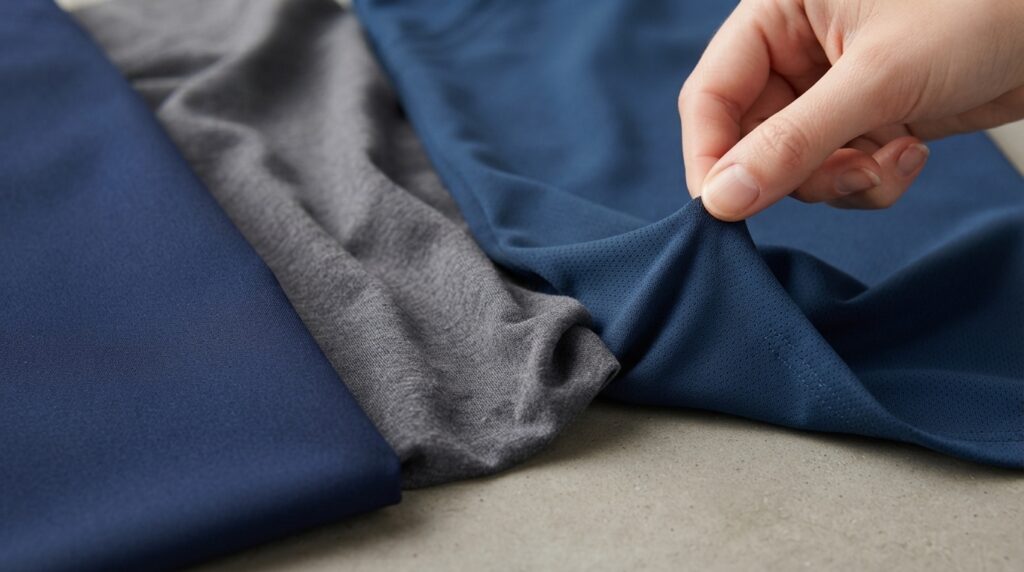
Look at the fiber blend
Scrubs may use polyester, recycled polyester, rayon, spandex, cotton, or combinations of different fibers.
Each fiber can contribute different characteristics.
Polyester is commonly used in workwear because it can support durability and practical garment care.
Rayon may contribute softness and fluid drape, depending on the fabric construction and blend.
Spandex is often included in smaller percentages to provide stretch.
Cotton is known for a familiar natural-fiber feel, although the performance of any garment depends on the full fabric construction rather than one fiber alone.
A fabric should be assessed as a complete blend. A percentage on a label does not automatically explain exactly how the finished garment will feel.
Consider stretch and recovery
Stretch allows a garment to expand during movement. Recovery describes how well the fabric returns toward its original form after being stretched.
For active healthcare roles, stretch may be useful when:
- Bending toward a patient.
- Reaching across equipment.
- Moving between sitting and standing.
- Walking quickly.
- Performing repeated tasks throughout a shift.
However, more stretch is not automatically better for every wearer. The garment still needs enough structure to maintain a professional appearance.
Think about fabric weight
Lightweight fabrics may feel more comfortable in warm environments or highly active roles. Heavier materials may feel more substantial to some wearers.
The ideal weight depends on several factors:
- Workplace temperature
- Activity level
- Layering needs
- Personal fabric preference
- Garment silhouette
A healthcare professional working in a warm clinic may prioritize a lightweight feel, while someone moving between cooler treatment areas may prefer layering with a scrub jacket.
Pay attention to drape
Drape describes how fabric hangs and moves around the body.
A softer or more fluid drape may feel less rigid during movement. A more structured fabric may create a different professional silhouette.
Neither characteristic is universally better. The goal is to select a fabric behavior that fits the wearer’s comfort and appearance preferences.
What makes scrubs comfortable for long workdays?
Comfort is the combined effect of fit, fabric, movement, temperature, seams, waistbands, and garment design.
A scrub set should therefore be judged as a complete system.
Waistband design can change all-day comfort
Scrub pants may use:
- Yoga-style waistbands
- Full elastic waistbands
- Half-elastic waistbands
- Drawstrings
- Combination elastic and drawstring systems
The best waistband depends on how the wearer prefers the pants to sit and how much adjustability is needed.
A soft yoga-style waistband may appeal to someone who prefers a flexible feel around the waist. A drawstring may provide more individual adjustment. Elastic construction can simplify fit and support easy dressing.
The important question is whether the waistband remains comfortable after sitting, standing, and moving for several hours.
Breathability matters during active work
Healthcare environments can vary considerably in temperature and activity demands.
A wearer who moves continuously may prioritize lightweight fabric and airflow. Another person may spend more time in a temperature-controlled office or treatment environment.
Breathability should be considered together with:
- Fabric weight
- Garment looseness
- Layering
- Activity level
- Workplace temperature
A loose-fitting garment is not automatically breathable, and a lightweight fabric is not automatically suitable for every climate or work setting.
Small fit problems become more noticeable over time
A seam that rubs, a waistband that rolls, a pocket that pulls, or a top that repeatedly rides upward may seem minor during a short fitting.
After a long workday, those repeated adjustments can become distracting.
This is why a practical scrub fitting should include several minutes of movement whenever possible.
How many pockets should medical scrubs have?
There is no universal ideal number of pockets.
Pocket needs depend on the wearer’s role and workplace rules.
Some healthcare workers regularly carry several small work items. Others work in environments where equipment and supplies remain nearby.
Before choosing scrubs, consider what is actually carried during a normal shift.
Common needs may include:
- Pens
- Small notebooks
- Work phones or communication devices
- Identification items
- Approved small tools
- Personal items permitted by workplace policy
Pocket placement matters as much as pocket count
A scrub top with several pockets may not be practical if those pockets are difficult to reach.
The same applies to scrub pants.
Consider whether the wearer prefers:
- Chest pockets
- Front patch pockets
- Side pockets
- Cargo pockets
- Zippered storage
The weight placed in a pocket should also be considered. A heavily loaded pocket can cause fabric to pull or affect how the garment moves.
The better approach is to select storage based on daily needs rather than automatically choosing the garment with the highest pocket count.
Should healthcare workers choose scrub tops and pants separately?
For many wearers, choosing tops and pants separately can improve fit.
A person may need one size in a top and another size in pants. Body proportions, preferred garment looseness, inseam requirements, and waistband preferences can all affect sizing.
Separate selection also allows healthcare professionals to choose different functional features.
For example, someone may prefer:
- A simple top with limited pockets.
- Scrub pants with additional cargo storage.
- A stretch-focused top.
- A different waistband construction in the pants.
Matching the collection, fabric, or color can still create a coordinated appearance while allowing more individualized fit.
How should scrub style affect the buying decision?
Professional appearance matters, but style should support the workplace rather than interfere with it.
Modern scrubs are available in a wide range of silhouettes. The right style depends on the wearer, employer requirements, and job duties.
Jogger scrub pants
Joggers generally have a narrower lower leg and fitted ankle area.
They may appeal to wearers who prefer a modern, close-to-the-body silhouette. The cuff and lower-leg fit should still be checked for comfortable movement.
Tapered scrub pants
Tapered pants gradually narrow toward the ankle.
They can provide a streamlined shape without necessarily using a jogger-style cuff.
Flare and wide-leg scrub pants
Flare and wide-leg silhouettes create more space through portions of the leg.
Wearers should consider garment length and workplace movement when choosing these styles.
Shaped and relaxed scrub tops
Some scrub tops create a more defined silhouette, while others use a relaxed or straight cut.
Neither option is automatically more professional. Fit, garment condition, color requirements, and workplace dress policies all contribute to professional appearance.
How important is scrub care and durability?
Medical workwear may be washed frequently. This makes care requirements an important part of scrub selection.
The CDC includes uniforms and scrub suits within the broader category of healthcare laundry and textiles and provides infection-control guidance for handling healthcare laundry.
Healthcare professionals should follow their facility’s policies regarding work clothing, contaminated garments, and laundering. They should also follow the garment manufacturer’s care instructions.
Before purchasing scrubs, check:
- Washing instructions
- Drying instructions
- Recommended water temperature
- Whether special care is required
- Fabric composition
- Color-care guidance
A garment that does not fit the wearer’s normal laundry routine may become inconvenient even if it initially feels comfortable.
Scrubs and PPE are not automatically the same thing
Ordinary uniforms or scrubs are generally not intended to function as personal protective equipment. OSHA has specifically distinguished uniforms or scrubs worn similarly to street clothing from PPE in its bloodborne pathogens guidance.
Where workplace hazards require protective equipment, employers and workers should follow applicable OSHA personal protective equipment requirements and facility policies. OSHA defines PPE as equipment intended to minimize exposure to workplace hazards.
NIOSH also separately discusses protective clothing used in healthcare, including gowns and coveralls intended to protect workers and patients from certain exposures.
This distinction is important when selecting everyday medical scrubs. Comfort, pockets, stretch, and professional fit do not replace required protective clothing for specific hazards.
How can healthcare professionals choose the right scrub size?
Start with the current size chart for the collection being considered.
Do not assume that the same labeled size will fit identically across every fabric, silhouette, or garment design.
When possible:
- Measure the body according to the size chart instructions.
- Check garment-specific sizing information.
- Consider preferred fit, such as closer or more relaxed.
- Evaluate the top and pants separately.
- Test normal work movements.
- Check pant length with typical work shoes.
A wearer between sizes should pay particular attention to the garment cut and fabric stretch.
Trying on different silhouettes can be particularly helpful because two pants in the same labeled size may feel different when one uses a yoga waistband and the other uses a structured or elastic waist construction.
What should you check before buying medical scrubs?
A practical final checklist can make the decision easier.
Fit
- Can you raise your arms without severe pulling?
- Can you sit comfortably?
- Can you bend and take a long step?
- Does the waistband remain secure?
- Is the pant length appropriate?
Fabric
- Does the fabric feel comfortable against the skin?
- Does it provide the desired stretch?
- Is the weight suitable for the work environment?
- Does the fabric drape in a preferred way?
Function
- Are the pockets accessible?
- Is there enough storage for normal work needs?
- Are closures and drawstrings easy to use?
- Does the design support repeated movement?
Work requirements
- Does the color meet employer requirements?
- Does the style fit the workplace dress code?
- Are additional protective garments required for specific tasks?
Care
- Can the garment be washed according to the wearer’s normal routine?
- Are the care instructions practical?
- Does the workplace have special policies for laundering work clothing?
Healthcare facilities may have their own procedures for clothing and contaminated textiles. The CDC’s healthcare laundry guidance discusses uniforms and scrub suits within healthcare laundry management.
Where should healthcare professionals look for medical scrubs?
The best buying route depends on whether the wearer already knows the preferred size, fabric, and silhouette.
Online product research can make it easier to review collections, fabrics, and available garment types. However, trying on scrubs may be useful when evaluating an unfamiliar cut or waistband.
Healthcare professionals who want to see garments in person can find an authorized scrub retailer and ask about available styles, sizes, and collections. The retailer pathway is designed to connect shoppers with independent sellers carrying the relevant scrub lines.
The most useful approach is to arrive with a clear idea of the features that matter most. Knowing whether comfort, stretch, lightweight fabric, pocket storage, pant silhouette, or professional styling is the priority makes the selection process more focused.
Final thoughts
Choosing medical scrubs should begin with the actual workday.
A nurse moving continuously through a long shift may prioritize stretch, breathable comfort, and accessible pockets. A healthcare professional working in a cooler environment may consider layering and scrub jackets. Someone who frequently carries work items may need specific pocket placement. Another wearer may place greater importance on fabric drape and a polished silhouette.
There is no single scrub design that suits every healthcare professional. The best choice balances fit, fabric, comfort, function, care requirements, and workplace expectations.
Instead of selecting scrubs based only on color or appearance, evaluate how the garment behaves while sitting, reaching, bending, walking, and working. That practical approach is more likely to lead to scrubs that remain comfortable and useful throughout the workday.
Frequently Asked Questions
How should medical scrubs fit?
Medical scrubs should provide enough room for normal work movements without excessive pulling or unnecessary loose fabric. The wearer should be able to sit, bend, reach, and walk comfortably. Fit should be checked through the shoulders, torso, hips, waist, and legs.
What fabric is best for medical scrubs?
There is no single best fabric for every healthcare professional. Polyester, rayon, spandex, cotton, and blended fabrics can provide different characteristics. Consider stretch, weight, softness, drape, care requirements, and the work environment when selecting fabric.
Are stretch scrubs better for long shifts?
Stretch can improve freedom of movement during bending, reaching, sitting, and walking. However, comfort also depends on garment fit, fabric weight, waistband design, seams, and breathability. Stretch should be considered as one part of the complete scrub design.
How many pockets should scrubs have?
The right number of pockets depends on the wearer’s daily work needs. Healthcare professionals should consider what they regularly carry and where they prefer storage. Pocket position and accessibility can be more important than simply having a large number of pockets.
Should scrub tops and pants be the same size?
Not necessarily. Many people have different sizing needs for the upper and lower body. Selecting tops and pants separately may provide a better overall fit while still allowing the wearer to coordinate fabric, collection, and color.
Are regular medical scrubs considered PPE?
Ordinary scrubs or uniforms are generally not intended to serve as PPE. OSHA distinguishes ordinary uniforms and scrubs from protective equipment intended to reduce exposure to workplace hazards. Required PPE should be selected and used according to workplace hazards, applicable standards, and facility policies.