A San Antonio car accident case is not worth one fixed amount just because a crash happened.
The value depends on proof.
Insurance companies, lawyers, and courts may look at what happened, who was at fault, how badly someone was injured, how medical treatment progressed, how much work was missed, what insurance coverage exists, whether future care is expected, whether bills or liens must be resolved, and whether Texas deadlines are approaching.
That is why a meaningful case-value review should not begin with a random settlement estimate. It should begin with a blueprint.
This guide explains the main factors that can affect the value of a San Antonio car accident case, what documents help support value, and why settlement should not be rushed before the full injury, evidence, coverage, and lien picture is clear.
Quick Answer
A San Antonio car accident case may be worth more when there is strong evidence of fault, prompt and consistent medical care, clear injury documentation, significant medical bills, lost wages, future treatment needs, serious vehicle damage, credible witnesses, available insurance coverage, and limited fault assigned to the injured person. A case may be worth less when evidence is missing, treatment is delayed, injuries are disputed, insurance coverage is limited, prior medical issues are unclear, liens reduce the net recovery, or the injured person is found mostly responsible.
If you were injured in a crash and need help understanding what may affect settlement value, speaking with a san antonio car accident attorney may help you review the claim file before making settlement decisions. For car-crash-specific guidance, you can also review resources from a San Antonio car accident lawyer. The Thompson Law San Antonio profile can serve as a local map and contact starting point.
Key Takeaways
- A car accident case is not valued by a simple average. It is built from proof, damages, coverage, and risk.
- Medical records, medical bills, wage proof, repair records, photos, witness information, crash reports, and insurance letters can all affect value.
- Texas fault rules matter. If the injured person is assigned too much responsibility, recovery can be reduced or barred.
- Policy limits matter. A serious injury claim may still face collection limits if available coverage is low.
- Settlement value and net recovery are not the same. Liens, medical balances, reimbursement claims, attorney fees, and case costs may affect what is received after settlement.
- A quick settlement may leave out future treatment, wage loss, unresolved bills, or unknown injuries.
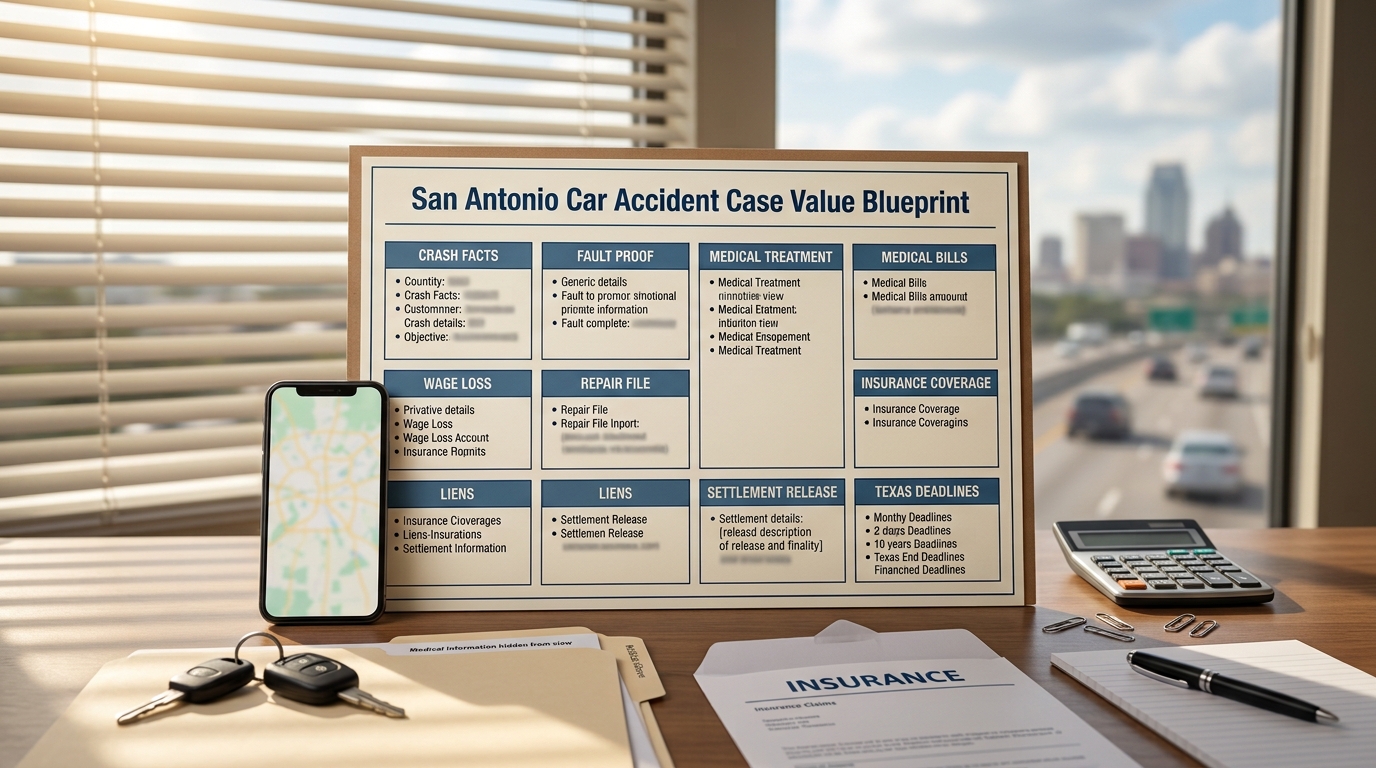
The San Antonio Case Value Blueprint
A case value blueprint has several parts. Each part answers a different question.
| Blueprint Section | Value Question |
| Crash Facts | What happened, where, and who was involved? |
| Fault Proof | Who caused the crash, and can it be proven? |
| Injury Proof | What injuries were documented after the crash? |
| Treatment Timeline | Was care prompt, consistent, and medically supported? |
| Medical Bills | What treatment costs were created? |
| Future Care | Will more treatment be needed? |
| Wage Loss | Did the injury affect work or earning ability? |
| Vehicle Damage | Do repair records support the crash force and timeline? |
| Coverage | What insurance policies may apply? |
| Liens and Balances | What must be paid or reimbursed from settlement? |
| Deadline Risk | Are Texas deadlines or government notice rules approaching? |
The stronger and more complete the blueprint, the easier it is to evaluate the claim.
Why There Is No Reliable “Average” Car Accident Settlement
People often search for an average settlement number after a crash. The problem is that averages can be misleading.
Two San Antonio crashes can look similar but have very different values because of:
- Injury severity
- Medical treatment length
- Surgery recommendations
- Diagnostic imaging
- Lost wages
- Future care
- Scarring or permanent limitations
- Fault disputes
- Witnesses
- Camera footage
- Vehicle damage
- Policy limits
- Uninsured or underinsured drivers
- Liens and reimbursements
- Prior medical history
- Texas legal deadlines
- Whether a lawsuit becomes necessary
A minor crash with no injury and clear insurance coverage may resolve mostly as a property-damage claim. A crash involving hospitalization, surgery, long-term impairment, missed work, and disputed policy limits may require a deeper legal and financial review.
The better question is not, “What is the average case worth?” The better question is, “What does the evidence prove in this case?”
Value Factor 1: Clear Fault Evidence
Fault is one of the first value drivers. The more clearly another driver caused the crash, the stronger the liability side of the claim may be.
Fault evidence may include:
- Crash report
- Driver statements
- Witness names
- Photos of the scene
- Photos of vehicle damage
- Traffic signal details
- Lane markings
- Skid marks
- Debris fields
- Dashcam footage
- Business camera footage
- 911 records
- Bodycam or dashcam footage, if available through the investigating agency
- Citations, if any
- Event data or vehicle information in serious crashes
- Commercial vehicle records, if a company vehicle was involved
Common San Antonio fault disputes may involve:
- Rear-end collisions
- Left-turn crashes
- Lane-change crashes
- Highway merging crashes
- Red-light or stop-sign disputes
- Intersection crashes
- Pedestrian or cyclist impacts
- Multi-vehicle chain-reaction crashes
- Rideshare, delivery, or commercial vehicle crashes
- Hit-and-run or uninsured driver crashes
Fault matters because Texas uses proportionate responsibility rules. If the insurance company argues that you were partly responsible, the value of the case may be reduced. If you are found more than 50 percent responsible, recovery may be barred under Texas law.
Value Factor 2: Crash Report and Official Records
A crash report can help support the basic accident record.
For San Antonio crashes, the San Antonio Police Department says police open-record requests may include crash or vehicle accident reports, and that crash reports are also available through the TxDOT Crash Report Online Purchase System.
TxDOT is the custodian of Texas crash records and provides eligible requesters access to Texas Peace Officer’s Crash Reports. TxDOT explains that qualifying investigated crashes involving injury, death, or apparent property damage of $1,000 or more must be reported to TxDOT not later than the tenth day after the crash.
A crash report may help document:
- Crash date
- Crash time
- Crash location
- Drivers
- Vehicles
- Insurance information
- Reported injuries
- Witnesses
- Citations
- Contributing factors
- Officer observations
- Report number
A crash report is helpful, but it is not the whole value file. Photos, medical records, repair documents, wage proof, witness information, camera notes, and insurance letters may also matter.

Value Factor 3: Medical Treatment and Diagnosis
Medical evidence is often the center of a car accident valuation.
Medical records may help show:
- When symptoms began
- What symptoms were reported
- What diagnosis was made
- Whether the crash was noted in the medical history
- Whether imaging was ordered
- Whether treatment was recommended
- Whether referrals were made
- Whether therapy was needed
- Whether medication was prescribed
- Whether work restrictions were given
- Whether future care is expected
Important medical records may include:
- Emergency medical services records
- Emergency room records
- Urgent care records
- Primary care records
- Orthopedic records
- Neurology records
- Imaging reports
- Physical therapy notes
- Pain management records
- Surgical consults
- Prescription records
- Mental health records for accident-related trauma
- Future-care recommendations
The type and severity of the diagnosis can affect value. A short soreness claim is valued differently from a case involving fractures, concussion, disc injury, surgery, nerve symptoms, permanent limitations, scarring, or long-term pain.
Value Factor 4: Treatment Timing and Consistency
Insurance companies often study the medical timeline.
They may ask:
- Did the injured person get care quickly?
- Were symptoms documented soon after the crash?
- Were appointments missed?
- Were there long gaps in treatment?
- Did the person follow referrals?
- Did the person complete therapy?
- Was treatment stopped because the patient improved or because of cost, transportation, work, or insurance problems?
- Did the doctor document future care or permanent restrictions?
Delayed care does not automatically ruin a claim. People may not feel symptoms immediately, and real-life barriers can interrupt treatment. But unexplained gaps can give insurers arguments to reduce value.
A strong treatment timeline should show:
- Accident date
- First symptoms
- First medical visit
- Follow-up visits
- Imaging
- Specialist referrals
- Therapy
- Work restrictions
- Symptom changes
- Future-care recommendations
- Reasons for any treatment gaps
The value of a case is easier to evaluate when the medical timeline is complete.
Value Factor 5: Medical Bills and Future Care
Medical bills often form part of the valuation discussion, but the total billed amount is not the only issue.
A value review may consider:
- Emergency care bills
- Ambulance bills
- Hospital bills
- Imaging bills
- Specialist bills
- Therapy bills
- Prescription costs
- Injection or procedure costs
- Surgery costs
- Medical equipment
- Future treatment
- Future imaging
- Future therapy
- Future surgery recommendations
- Long-term pain management
- Rehabilitation needs
Future care matters because a settlement release may end the claim. If the case settles before future treatment is understood, the injured person may be left with later bills that were not included in the settlement.
Before accepting a settlement, ask whether treatment is complete, whether all bills are included, whether future care is expected, and whether the settlement release covers unknown injuries or future medical needs.
Value Factor 6: Lost Wages and Work Impact
A car accident case may be worth more when the injury causes documented income loss.
Useful wage-loss proof may include:
- Pay stubs
- Timesheets
- Employer letters
- Missed-shift confirmations
- Work restriction notes
- Tax records
- Contractor invoices
- Business income records
- Proof of used sick time
- Proof of used vacation time
- Reduced-duty records
- Job description
- Notes showing work tasks the injured person cannot perform
Work impact may include:
- Missed days
- Reduced hours
- Lost overtime
- Lost bonuses
- Missed contracts
- Reduced productivity
- Job duty changes
- Forced career changes
- Lost earning capacity
A wage claim is stronger when medical restrictions match the work loss. For example, a doctor’s restriction against lifting, bending, or standing may help explain why someone missed warehouse, construction, delivery, nursing, restaurant, retail, or military-adjacent work.

Value Factor 7: Pain, Daily Limits, and Human Impact
Some losses do not appear neatly on a receipt.
A serious crash may affect:
- Sleep
- Driving confidence
- Walking
- Sitting
- Standing
- Lifting
- Childcare
- Household tasks
- Exercise
- Family activities
- Social life
- Mood
- Independence
- Mobility
- Travel
- Military duties or physical requirements
- Caregiving responsibilities
A simple recovery journal can help document daily impact. Keep it factual and dated.
Helpful notes might include:
- Pain levels
- Missed activities
- Medication side effects
- Sleep problems
- Mobility limits
- Anxiety while driving
- Household tasks you needed help with
- Appointments missed because of pain
- Activities you stopped doing
- Symptom changes after work or driving
The goal is not to exaggerate. The goal is to preserve the day-to-day impact before memory fades.
Value Factor 8: Vehicle Damage and Property Loss
Vehicle damage does not always predict injury severity, but it can still affect how insurers discuss the claim.
Save:
- Damage photos
- Repair estimates
- Supplemental repair estimates
- Body shop invoices
- Total-loss paperwork
- Rental car receipts
- Towing bills
- Storage bills
- Photos of damaged personal items
- Child seat replacement documentation
- Repair-shop communications
- Insurance valuation letters
Insurance companies may compare the medical claim to the visible damage. If the vehicle damage appears minor, they may argue that the injury should also be minor. Detailed records can help show hidden damage, repair supplements, airbag deployment, frame issues, or the crash mechanics.
Property damage is only one part of the case value blueprint. The medical record still matters most for injury value.
Value Factor 9: Insurance Coverage and Policy Limits
Coverage can affect case value and actual recovery.
Texas law requires minimum liability coverage of at least $30,000 for injuries per person, up to $60,000 per accident, and $25,000 for property damage. These limits are often called 30/60/25 coverage.
That matters because a serious injury claim may exceed the at-fault driver’s policy limits.
Coverage that may need review includes:
- At-fault driver liability coverage
- Your own collision coverage
- Personal injury protection
- Medical payments coverage
- Uninsured motorist coverage
- Underinsured motorist coverage
- Rental coverage
- Health insurance
- Commercial vehicle coverage
- Rideshare coverage
- Umbrella or excess coverage
Texas auto policies may include or offer coverages that can matter after a crash. Personal injury protection, medical payments, and uninsured or underinsured motorist coverage may help with medical bills depending on the policy and facts.
Do not assume the first policy identified is the only available coverage.
Value Factor 10: Uninsured, Underinsured, and Hit-and-Run Issues
Case value can be complicated when the at-fault driver has no insurance, not enough insurance, or leaves the scene.
In those situations, your own insurance may become important.
Potential coverage sources may include:
- Uninsured motorist coverage
- Underinsured motorist coverage
- Collision coverage
- Personal injury protection
- Medical payments coverage
- Health insurance
TDI explains that if the other driver is uninsured or drove away, collision, medical payments, PIP, and UM/UIM coverage may apply depending on the policy.
A hit-and-run or uninsured driver case may require more evidence because the identity of the driver, the lack of coverage, or the accident facts may be disputed.
Value Factor 11: Comparative Fault and Blame Shifting
Texas fault rules can directly affect case value.
Under Texas proportionate-responsibility law, a claimant may not recover damages if their percentage of responsibility is greater than 50 percent. If the claimant is not barred, the recovery can be reduced by their percentage of responsibility.
Insurance companies may try to reduce value by arguing that you:
- Were speeding
- Followed too closely
- Failed to avoid the crash
- Changed lanes unsafely
- Were distracted
- Did not see a hazard
- Delayed medical care
- Were not wearing a seat belt
- Gave inconsistent statements
- Had a prior injury unrelated to the crash
Evidence matters when blame is disputed. Photos, videos, witnesses, crash reports, medical records, vehicle damage, and camera footage can help respond to fault arguments.

Value Factor 12: Liens, Balances, and Net Recovery
The settlement amount and the amount someone keeps are not always the same.
Settlement funds may need to account for:
- Health insurance reimbursement
- Medicare or Medicaid issues
- Hospital liens
- Provider balances
- Letter-of-protection balances
- Workers’ compensation reimbursement
- Case costs, if represented
- Attorney fees, if represented
- Medical bill reductions
- Unpaid treatment balances
This is why case value should be reviewed in two ways:
- Gross case value: the settlement or judgment amount.
- Net recovery: what may remain after liens, reimbursements, fees, costs, and balances are addressed.
A settlement that looks large may be less helpful if unpaid medical balances are high. A careful value review should include both the gross number and the expected net result.
Value Factor 13: Settlement Timing
A case may be undervalued if it settles too early.
Early settlement can be risky when:
- Treatment is ongoing
- Imaging has not been reviewed
- A specialist appointment is pending
- Surgery has been recommended
- Future care is unknown
- Medical bills are incomplete
- Wage loss is still developing
- The crash report is missing
- Witnesses have not been contacted
- Camera footage may exist
- Policy limits are unknown
- Liens are unresolved
- Release language has not been reviewed
TDI’s auto insurance guide warns that when another driver’s insurer offers a medical settlement, the insurer will ask for a release promising not to file more claims for the accident. Future medical treatment should be considered before signing.
Settlement should follow the evidence, not pressure.
Value Factor 14: San Antonio Roadway Context
Location can affect evidence, fault, coverage, and case investigation.
San Antonio crashes may involve:
- I-10
- I-35
- I-37
- Loop 410
- Loop 1604
- US 281
- Highway 90
- Wurzbach Parkway
- Bandera Road
- Culebra Road
- Military Drive
- Fredericksburg Road
- Downtown streets
- Medical Center traffic
- Lackland-area routes
- Stone Oak corridors
- School zones
- Construction zones
- Rideshare pickup areas
- Commercial delivery corridors
San Antonio’s Vision Zero program describes the city’s plan to eliminate traffic fatalities and improve transportation safety. That does not prove fault in a specific case, but it reinforces why crash location, road design, serious-injury evidence, and traffic context may matter.
What Can Increase the Value of a Car Accident Case?
Factors that may support higher value include:
- Clear fault by another driver
- Strong crash report or citations
- Credible witnesses
- Photos or videos
- Serious injuries
- Prompt medical care
- Consistent treatment
- Objective findings on imaging
- Surgery or future-care recommendations
- Long-term limitations
- Significant medical bills
- Documented lost wages
- Reduced earning ability
- Strong repair records
- Commercial vehicle involvement
- Higher available insurance coverage
- Limited fault assigned to the injured person
- Well-documented pain and daily-life impact
No single factor guarantees a specific result. The value usually comes from how the evidence fits together.
What Can Reduce the Value of a Car Accident Case?
Factors that may reduce value include:
- Disputed fault
- Missing photos
- Lost witnesses
- No crash report
- Delayed medical care
- Long treatment gaps
- Missed appointments
- Incomplete medical records
- Weak wage proof
- Prior injuries with unclear records
- Low visible vehicle damage
- Policy limits too low for the injury
- Unresolved liens
- Inconsistent statements
- Social media posts that can be misread
- Signing a release too early
- Waiting too long to ask about Texas deadlines
A lower offer does not always mean the case has low value. It may mean the insurer is missing records, disputing fault, questioning medical treatment, or using policy limits as leverage.
Texas Deadlines That Can Affect Value
Texas injury claims are time-sensitive.
In many Texas personal injury cases, a lawsuit must be brought not later than two years after the day the cause of action accrues under Texas Civil Practice and Remedies Code Section 16.003.
Some claims can involve shorter notice issues. If a governmental unit may be involved, Texas Civil Practice and Remedies Code Section 101.101 provides that a governmental unit is entitled to receive notice of a claim under the Texas Tort Claims Act not later than six months after the incident.
Deadline pressure can reduce settlement leverage. Settlement talks do not automatically stop legal deadlines. If time is short, the value review becomes more urgent.
Documents That Help Evaluate Case Value
Use this checklist when preparing for a value review.
Crash and Fault Documents
- Crash report
- Report number
- Photos
- Videos
- Witness names
- Camera locations
- Driver information
- Insurance information
- Citation details
- 911 or open-records notes
- Vehicle damage photos
Medical Documents
- EMS records
- Emergency room records
- Urgent care records
- Doctor notes
- Imaging reports
- Specialist records
- Therapy notes
- Surgery recommendations
- Medical bills
- Prescription receipts
- Work restrictions
- Future-care notes
Financial Documents
- Pay stubs
- Timesheets
- Employer letters
- Tax records
- Contractor invoices
- Missed-shift records
- Repair estimates
- Rental receipts
- Towing receipts
- Storage bills
- Out-of-pocket receipts
Insurance Documents
- Claim numbers
- Adjuster contact information
- Coverage letters
- Denial letters
- Policy declarations pages
- Settlement offers
- Recorded statement requests
- Medical authorization requests
- Release documents
Net Recovery Documents
- Health insurance payment summaries
- Hospital lien notices
- Provider balances
- Medicare or Medicaid correspondence
- Workers’ compensation information
- Attorney fee agreement, if represented
- Case cost records, if represented
Questions to Ask Before Accepting a Settlement
Before accepting a settlement offer, ask:
- Is medical treatment complete?
- Are all medical bills included?
- Is future treatment expected?
- Are lost wages documented?
- Is future earning impact possible?
- Are repair, rental, towing, and storage issues resolved?
- Are all insurance policies identified?
- Are policy limits known?
- Are PIP, MedPay, UM, and UIM issues reviewed?
- Is fault being disputed?
- Is any percentage of responsibility assigned to me?
- Are liens and reimbursements identified?
- What will the net recovery look like?
- Does the release cover unknown injuries?
- Does the release affect property damage or UM/UIM claims?
- Are Texas deadlines approaching?
If too many answers are unknown, the case may not be ready for settlement.
FAQ
A case-value estimate usually depends on fault evidence, medical records, medical bills, treatment status, lost wages, future care, vehicle damage, insurance coverage, policy limits, liens, and Texas deadline issues.
No. Medical bills matter, but they are only one part of the value review. Future treatment, lost wages, pain, daily limitations, fault disputes, coverage, liens, and settlement risk may also matter.
Yes. Texas proportionate-responsibility rules can reduce recovery based on assigned fault. If a claimant is found more than 50 percent responsible, recovery may be barred.
Be careful. A first offer may arrive before treatment is complete, future care is known, wage loss is documented, liens are reviewed, or release language is understood.
Bring the crash report, photos, videos, medical records, medical bills, repair estimates, wage proof, insurance letters, settlement offers, lien notices, and any release documents.
Final Thoughts
A San Antonio car accident case is worth what the evidence, damages, coverage, and Texas law can support.
The strongest value review looks beyond a quick settlement number. It asks who caused the crash, what injuries were documented, what treatment is still needed, how work and daily life changed, what insurance coverage exists, what liens must be resolved, and whether deadlines are approaching.
Before signing a settlement release, make sure the blueprint is complete: fault proof, medical records, bills, wage loss, future care, vehicle damage, coverage, liens, net recovery, and Texas timing.